

Mumbai
Although we have been to India several times we have never been to Mumbai. We also thoroughly enjoy seeing the big cats on our regular trips to South Africa on Safari , so we decided to combine a trip to India visiting Mumbai with Bandhavgarh to see the tigers in the wild. This will be quite a busy trip with early mornings so once the India section is finished, we’re off to Ananea in the Maldives for a spot of rest and some diving.
The trip didn’t get off to a brilliant start due to Mr Donald Trump’s shenanigans in the Middle East and Paul getting wrong date on visa wasn’t his finest hour. However, despite being rerouted over North Africa, we arrived ahead of schedule.
Mumbai
Mumbai, often called the “City of Dreams,” offers a mix of cultural landmarks, historical sites, vibrant markets, and scenic coastal spots. Mumbai’s diversity ensures there’s something for everyone, whether you’re into history, culture, food, or just soaking up the city’s vibrant energy.
Mumbai New Coastal Road: on way from the airport we passed through the iconic Bandra-Worli Sea Link, a well-known cable-stayed bridge, then on to the new Coastal Road and finally the underground tunnel that passes beneath the Priya Darsahni Park.
As we’d just arrived the first day is about getting over jet lag and perhaps finding our bearings.
Mumbai City Tour
There is so much to see in this city, so it was easiest to just get our driver to take us to see some of the highlites, these are the ones that we chose:
Marine Drive: is one of the most beautifully laid boulevards in southern part of Mumbai. The C shaped area in South Mumbai, Marine Drive is also called the “Queen’s Necklace”.
Girgaon Chowpatty: is a public beach along the Queen’s Necklace adjoining Marine Drive and is great for an evening stroll and snacks.
Sri Sri Radha Gopinath Temple: Sri Sri Radha Gopinath Mandir is a Hare Krishna temple, community, and ashram dedicated to the practice of bhakti-yoga and home to a loving community of practicing Hare Krishna devotees and over 200 resident monks.
Hanging Gardens: offers green space and trees amongst the heavily congested city. Along with numerous hedges carved into the shapes of animals, the gardens feature a prominent flower clock at its centre and the ‘Old Woman’s Shoe’ or the ‘Boot House’.
Jain Temple: Babu Amichand Panalal Adishwarji Jain Temple, A Holy religious temple of jain community who follows Jainism in Mumbai is located at Malabar Hills.
Antilla Residence: located on Billionaires’ Row, is the residence of the Indian billionaire businessman Mukesh Ambani and his family. It was valued at US$4.6 billion in 2023 and is the world’s second most valuable residential property, after British crown property Buckingham Palace, and the world’s most valuable private residence.
Haji Ali Dargah: is one of the most recognisable landmarks of Mumbai, a Sufi shrine and monument to Pir Haji Ali Shah Bukhari, a Sufi saint and a wealthy merchant from Uzbekistan and is located on an islet off the coast of Worli.
Dhobi Gat Mumbai: Dhobi Ghat is an open air laundromat in Mumbai, India. The washers, known as dhobis, work in the open to clean clothes and linens from Mumbai’s hotels and hospitals.
Chhatrapati Shivaji Terminus Area Fort: formerly known as Victoria Terminus, is a historic railway station and a UNESCO World Heritage Site in Mumbai, Maharashtra, India which serves as the headquarters of the Central Railways.
This is also a great area to watch the dabawal at work.
Other places to see are:
Dharavi Slums: is one of the world’s largest slums with an area of 2.4 sqkm and a population of about 1,000,000 making it one of the most densely populated areas in the world. Dharavi has an active informal economy in which numerous household enterprises make leather, textiles and pottery products. The total annual turnover has been estimated at over US$1 billion.
Mumbai Elephanta Caves
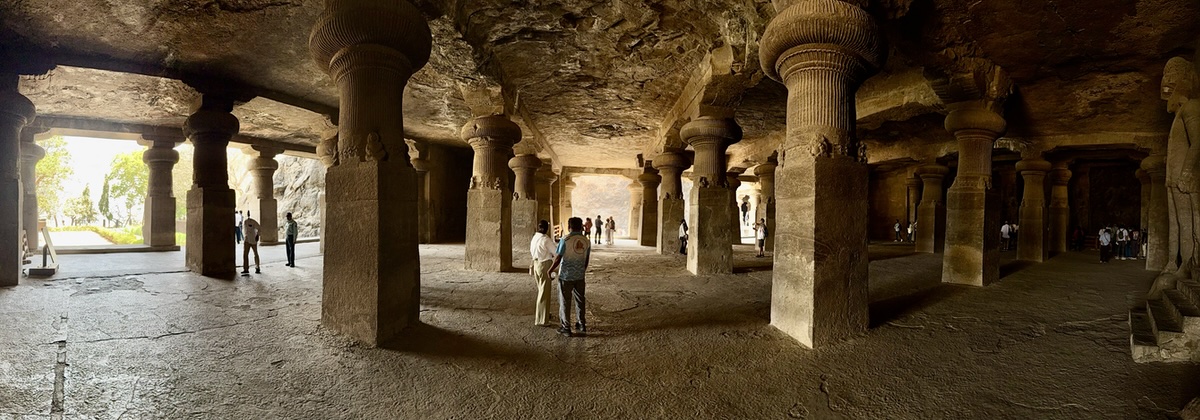
Next up is a 1 hour ferry ride across to Elephanta Island in Mumbai Harbour to see the Elephanta Caves. The caves are a UNESCO World Heritage Site and feature 5th-8th century rock-cut temples dedicated to Lord Shiva.
Besides the caves, the island features two hills (Gun Hill and Stupa Hill) and a small museum, offering panoramic views of Mumbai’s harbor.
Gateway of India: is a monumental arch on the waterfront, erected to commemorate the landing of King George V for his coronation as the Emperor of India. He was the first British monarch to visit India.
As we were in the right area this afternoon we decided to have a little retail therapy:
Colaba Causeway and market: is famous for shopping and food. From cheap street clothes to fashionable boutiques, this lane, which houses old buildings from the British Raj, has it all, clothes, shoes, purses, and even jewellery in the latest designs.
Crawford Market: is one of South Mumbai’s most famous markets named after Arthur Crawford, the first Municipal Commissioner of the city, the market was later renamed to honour Indian social reformer Mahatma Jotirao Phule.
Fashion Street: Is a long stretch of over 150 stalls selling everything from ripped jeans and funky t-shirts to sneakers and watches.
Mumbai Bollywood
Today is Bollywood. We’re off to learn about Bollywood’s history, and maybe even catch a live shoot.
Mumbai is the home to Bollywood which is the massive Hindi-language film industry and is one of the largest production centers in the world. Films are known for being 3-hour spectacles combining multiple genres, often featuring star-crossed lovers, dramatic family conflicts, and musical numbers. While India remains the biggest market, Bollywood has a massive following in Britain and globally.
This is Paul using artificial intelligence and video effects to save the world against the zombies
Lynn teaching the world to sing
Last day in Mumbai, so we decided to go to the Taj for high tea. A bit of a colonial hotel, a real tourist attraction but I guess we are tourists so it would be rude not to.